
Episode 8: Diversified Cropping and Cattle Integration with David Dobbins
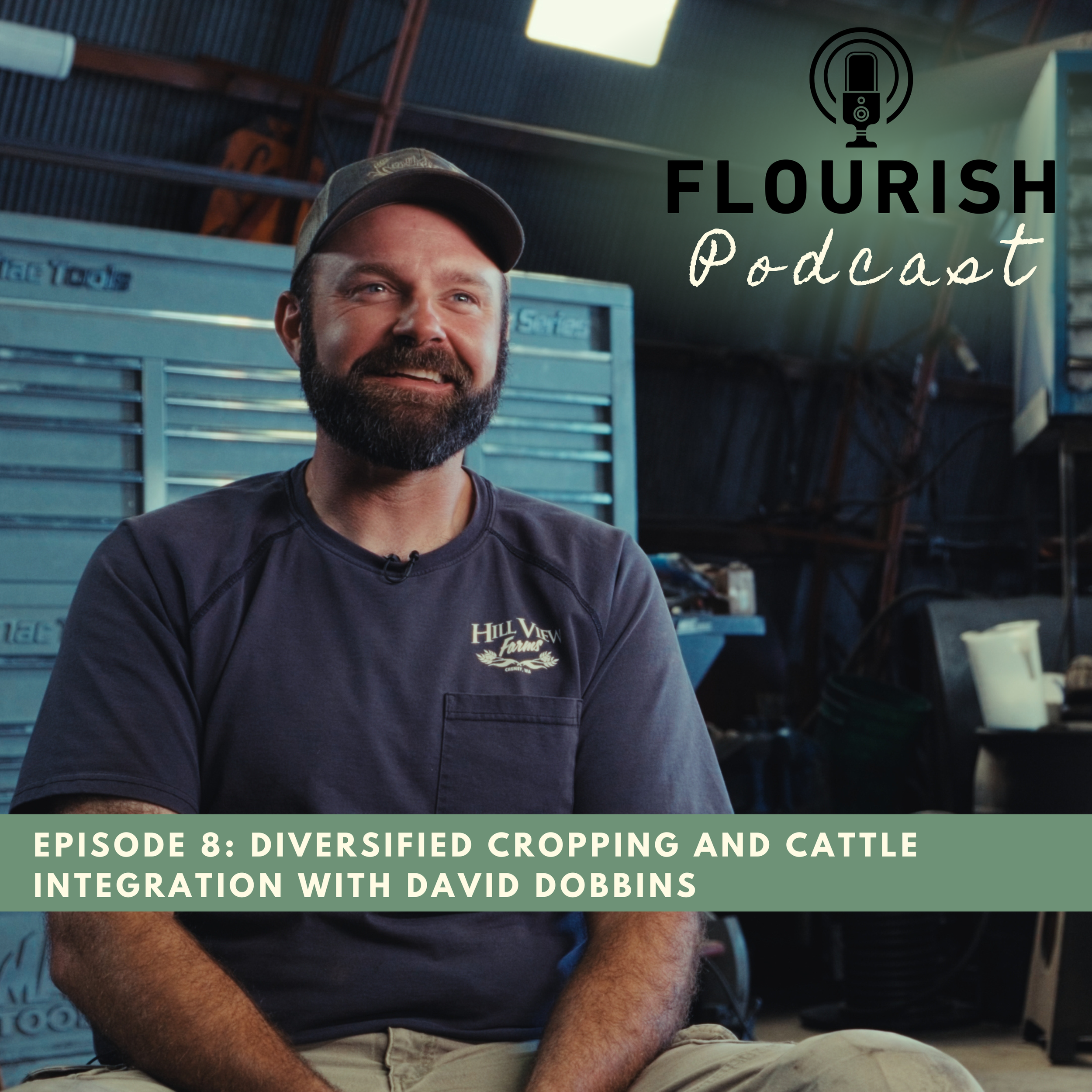
David Dobbins
About the episode:
Join us for a conversation with David Dobbins to discuss his transition to more diversified crop rotations, his experience grazing cows on cover crops, and the infrastructure investments that made these changes possible. He shares interesting observations from the last three years of the FLOURISH trials, as well as the challenges he has faced along the way.
David is a participant in the FLOURISH on-farm trials.
About the podcast:
Welcome to the FLOURISH Podcast, where we at the Palouse Conservation District interview farmers, ranchers, and researchers on topics related to conservation agriculture. FLOURISH, also known as Farmers Leading Our United Revolution in Soil Health, is a farmer-led conservation innovation project to support the widespread adoption of soil health practices by integrating cover crops and livestock into farming operations in the Inland Pacific Northwest. The ambitious purpose of FLOURISH is to not only regenerate our soils, but also our rural communities by creating opportunities for younger generations to return to productive, sustainable farms. On this podcast, we bring you updates from on-farm trials, research, findings, and advice from farmers.
The views and opinions expressed on the FLOURISH Podcast are those of the guests and do not necessarily reflect the official policy or position of Palouse Conservation District or the USDA Conservation Innovation Grants program. Any content provided by our Guests are of their opinion and are not intended to malign any religion, ethnic group, club, organization, company, individual, or anyone or anything.
-
Intro
Hello, and welcome to the FLOURISH Podcast, where we at the Palouse Conservation District interview farmers, ranchers, and researchers on topics in conservation agriculture. FLOURISH, also known as Farmers Leading Our United Revolution in Soil Health, is a farmer-led conservation innovation project to support the widespread adoption of soil health practices by integrating cover crops and livestock into farming operations. The ambitious purpose of FLOURISH is to not only regenerate our soils, but also our rural communities by creating opportunities for younger generations to return to productive, sustainable farms. On this podcast, we bring you updates from on-farm trials, research findings, and advice from farmers.
Ryan Boylan
Hello, and welcome back to the FLOURISH Podcast. I'm here today with David Dobbins and Hillview Farms. David, thanks for joining us.
David Dobbins
No problem. Good to be here. Glad you could make it out.
Ryan Boylan
Would you mind just telling us a little bit about your farm, like where we are, how much rain you get, what sort of crops you grow?
David Dobbins
Sure. We're located in Cheney, Washington, just 20 minutes out of Spokane. We get 14 to 16 inches of rainfall, and we try to run a continuous cropping system, and we're integrating lots of different aspects from biology to full-on cover crop with livestock, trying to manage all the things in between with, you know, trying to be base with wheat grain crops to the canola, the peas, growing alfalfa, different types of grass seed, more reclamation grasses. But we started in to get diversified in our crop portfolio, trying to actually focus on soil health, and in that we've diversified our problems, but we've diversified to the betterment, I think, of the soil and the farm, but not to say it hasn't been a very interesting rough road, and it continues to be. It's just understanding what outcomes can you expect that are going to be realistic moving forward.
Ryan Boylan
Yeah. Can you – what’s like your standard crop rotation. If there is a standard? It sounds like it's all over the board.
David Dobbins
That's my favorite question, standard crop rotation. Do we think we have a standard crop rotation? Well, if you try something new every year, then you don't have a standard crop rotation.
I would like to say that we're trying to move to either two years of grass, and then one year or two years of alternative crop, and that's where we're really trying to play out the cover crop scenario. I grew sunflowers and sorghum one year, and safflower, buckwheat, plus wheat, plus barley, plus peas, and then it was a lot to take on and too much in one year.
Ryan Boylan
Did you harvest that?
David Dobbins
So, we successfully harvested with a combine all the sunflowers, all the sorghum, and all the flax, but that's not without issues. The one year the flax got snowed on in a windrow. There was one year I slid the combine down the hill backwards in mud. We took Thanksgiving off and we molded sorghum in the grain dryer. And the machine that's supposed to dry the crop so, it's stable inside of a grain bin for indefinitely...when that doesn't work and it gets plugged up or you didn't have enough crop because I only grew probably 20 acres, needed 40 acres worth to actually get the system to work and dry the crop appropriately. And we end up molding things and having a lot of fun digging that out by hand. So...
Ryan Boylan
So there's like so many challenges. (laughs)
David Dobbins
So live and learn. That was after we learned how to run a grain dryer too. In corn country, other parts of the United States, they have full, large drying capacity systems that are set up and turn key. Like you didn't think about it. You just turn the key on and go. You dried a crop, you put it in a bin and that's standard protocol. That is not standard protocol in the Pacific Northwest.
Ryan Boylan
So it sounds like one of the motivations for getting into cover crops was diversifying. And is there also a link - so diversifying a crop rotation - is there a link with soil and to your soil?
David Dobbins
So with...I guess going back, we went quite a few years ago, we went on a trip. It was part of the Shepherd's Grain Young Gun Collaborative. We went back to see Dwayne Beck at the Dakota Lakes Research Farm in South Dakota. And through that trip, we saw a lot of different crops and we saw a lot of things that they were doing with no-till. We saw a lot of things that we were doing, they were doing with crop diversity, water infiltration rates, getting the soil back to grow more than just wheat.
And so I think a lot of us came back with a different mindset from that crop tour that we can reach out and we can go a lot farther and do a lot more things. And it's not that we had the guidebook by any means. We were going to start out as conventional farmers to then high-disturbance, no-till farmers and then end up as low-disturbance, disc drill, no-till farmers. And that's a change in equipment profile, but it also needed to be a change in fertilizer management.
Ryan Boylan
Now you're also kind of a rancher? (laughs)
David Dobbins
Yes. So you can become a rancher. You can be a livestock specialist. You can be a rangeland management specialist. You can go a lot of different ways with it. At that time, we started with just trying to diversify the crop rotation.
And I wasn't seeing the results that I wanted nearly as fast. And several different people said, “Once you add livestock, you will change your system faster than you could ever believe.” After having livestock on the farm for 60 years, growing up with livestock, my grandfather, my dad having a small operation, being able to sell what we produced as local beef, we didn't have the numbers to manage the crop ground in a cover crop capacity and have a benefit on a scalable acre.
We could manipulate one acre, but we couldn't actually get far enough. And that's where I ended up selling all our cows, the calves, the yearlings, the bull, selling that whole set and that whole business model. I don't know if that was the right choice now, but that's what I did.
And then I found a partner that could bring in hundreds of animals to be able to allow us to graze small paddocks, get our high intensity grazing onto these cover crops, because the best way to manage a diversified cover crop, I felt, after growing them as a monoculture, we needed to blend them and never run them through a grain dryer again. So let's run them through a cow. I was familiar with cattle. The opportunity to get cattle was way...the opportunity to get cattle was more efficient and more practical. And so we decided to use cattle other than other species of protein. That was going to be a lot of sheep and a lot of pigs or a lot of chickens or some other way we could do it. But for right now, we focused on the cattle and decided to build a lot of fence.
Ryan Boylan
That's what I was going to ask, yeah. So you sold the cattle and then you ended up bringing in like hundreds of cattle. Can you just talk about like what that transition was like?
David Dobbins
So I had some very well-trained cows that I think my dad could pet at least half of them. And that means the corral system that we used could entail pallets with baling twine, and we could get by without adding really any more infrastructure.
When we needed to switch gears and actually keep hundreds of animals in, we needed to upgrade fence because my dad had ripped out all the other fence. And we needed to be able to be mobile and cows and mobile and fence and water is not in a lot of people's vocabulary. When we started this plan...
Ryan Boylan
And sorry, how long ago was this?
David Dobbins
So three years ago, we started with a partner. We decided for sure on February 14th, we were going to bring in hundreds, shooting for 500 head to graze livestock on May 1st. I had no water other than a well. With an old pump that worked most of the time. And a corral system that held the old cows in.
Ryan Boylan
Yeah. Made of pallets and baling wire. (laughs)
David Dobbins
Made of just whatever we had. And it was fine. And we made it work. But by May 1st, we had ordered and installed a new pump, a new static water booster pump, bought enough lay flat hose to go over 3,000 feet away from a charged water spigot and bought like 12 miles of fence. And by May 1st, at least half of it was up. So we were in a usable state. But we decided to fence two different sides of the road. So that kind of doubles your fencing costs too.
So we doubled down, took all our fun money and bought a lot of fence and upgraded a lot of water and then started the water battle issue of, how do you actually keep a constant amount of water in a usable state that is cow proof?
And cow proof is a general term of, what can a cow lick, chew, beat up, step on, or just look at wrong and create an issue? Because when you are trying to keep livestock watered in the middle of the summer, we need to have, at a minimum, probably 15 gallons a day per head.
When it's really hot, you could be up to 30. Uh, there's times in the spring, they may only use 10 gallons a day, but just using the 10 times 500. That is a larger tanker every day, all day.
Ryan Boylan
So that first year you spent a lot of time hauling water, or somebody did?
David Dobbins
So we actually ended up getting the, a semi tanker, and we had it out in the field, hooked to a tractor and we were ran that lay flat hose up to it and was pumping in. And so we were trying to hold the water in the field, in a tanker, and gravity down to some floats. Then we realized that we farm on hills. We knew we were on hills, but then water troughs floats like level ground and nothing we had was ever level.
Ryan Boylan
Yeah.
David Dobbins
So we would just have a lot of leakage, uh, because just a float would trickle over because it'd fill up and then it would run over the side of a tote because it was on the hill. And we were thinking we had all these animals, we needed so much capacity and so big and wide and it, we didn't because it created more issues.
Ryan Boylan
So what, like what has changed since that first year? Like, what did you learn in that first year that now you've put into practice? Like do you still have as many cattle or...
David Dobbins
So we still have a large volume. We were down a little bit this year, um, from years past, but, um, negligible on that number. We were able to implement some in-ground water pipe to then have access points throughout the farm and throughout our fenced area.
Ryan Boylan
Nice.
David Dobbins
So now we can run less hose to be able to have a charge line and a gravity feed line with more capacity for 24 hours a day. We then are able to go with a different tire mobile trough design that allows us to have high capacity water flow and we can be mobile and move them each and every day if we choose to. We could set up and be able to, uh, set up paddocks and water so they could be there for either one day, three days, five days. We had the water system and there was no tractor, no semi tanker...
Ryan Boylan
No hoses that cows could step on. (laughs)
David Dobbins
You got more creative with fencing so that that electric power line protected your hoses and you just strategized and you were prepared and had a plan for four days out instead of what you thought you should have done last week. Um, so we were able to set up, plan ahead, and actually be more successful in our moving and our intensity and dictating our intensity of mob grazing.
Ryan Boylan
Cool. So you talked about bringing, um, someone in that could help with the cattle. Could you talk a little bit about that arrangement and like, how did you guys get connected?
David Dobbins
So I was part of the Spokane Biofarming Group. We, uh, got connected with a partner, um, that had access and more contacts and was really on the same thought process of wanting to get livestock back onto farm ground and want to make an impact through intensity of grazing. And they were willing to provide, um, the labor and manpower, but they didn't have a proven system either.
We had proven, talked about concepts, but when we take it from concept to reality, we both learned an extreme amount and we both spent a lot of money. And so these types of projects aren't for the faint of heart that, this isn't a “get in and get out” mentality. It has to be for a long-term setup, or it's not...the numbers will not work.
Ryan Boylan
Right. That's what I was thinking too. It's capital investment in the farm almost. So in the farm itself and then maybe in the soil also, or I don't know how you look at it. Yeah.
David Dobbins
This project is a capital investment into the farm for infrastructure and into the soil. We're going...where we run into problems is, we have to understand there's capital investment and then there's cash flow. Cash flow needs to be there to be able to keep the system going because, the FLOURISH grant paid for some cover crop seed - that didn't cover the whole bill. (laughs)
Ryan Boylan
(laughs) Right, right, right.
And the FLOURISH grant was great in allowing us to have flexibility to say, we need to spend money to be able to get a little bit of water, a little bit of a cover crop seed, a little bit of fence and, or if it needed to pay labor or whatever, we had flexibility. And I just, I can't thank the grant providers and all the ones that helped us get that grant because without flexibility in this system, we wouldn't know what we should have asked for to start with. And if you lock us in to say we can only pay for a certain variety or mix of cover crop, that might be totally different than what I actually needed. And the system may not have been going forward as much.
Ryan Boylan
Yeah. So like the flexibility and offsetting some risk is good. Can you just talk about, so yeah, the podcast is all about Farmers Leading Our United Revolution in Soil Health, which is FLOURISH. And can you just talk about how you got involved in that?
David Dobbins
So I had this wild idea, of let's sell the cows and get some cows. And then I believe Tami Stubbs called me and said, “Hey, I've heard you're doing a few things.” And it might've been that I was just trying cover crop. We hadn't even talked about cows. Then I had a meeting with Tami. She came up and we're standing around in the shop again. And she just got some really white eyes, like, “Whoa, I think we're a little behind the eight ball and where this guy's headed.”
Ryan Boylan
Yeah.
David Dobbins
And, but it was great because it was, I was asking the questions and she's like, “I don't know, but this is what this grant is for.”
Ryan Boylan
Yeah. Yeah. Cool. Okay.
David Dobbins
“You totally fit. Let's sign you up.” It's like, okay. And so that just started the relationship with the Palouse Conservation District and the grants. And, and we were able to work together with the FLOURISH grant and all the manpower that was provided to do a lot more than just worry about cattle, just because the soil testing, the moisture monitors, which told us it was dry and it was still dry, but we have moisture data that says it was dry. It's not our fault.
Ryan Boylan
Okay. Let's go back to just cattle grazing cover crops.
David Dobbins
Okay.
Ryan Boylan
What, how did the cows just, do you have any observations of like how the cows take to the cover crop? Like, do they like it?
David Dobbins
While grazing cover crop, there's some pretty big things we need to watch out for...is did you have a plan and did you plant a cover crop, let's say in the fall so that you have a larger biomass to go graze in the spring? Within, when we say cover crop, we have to also tease out the idea of there's a difference between cover crop and we just wanted to hit soil compaction issues.
Ryan Boylan
Right. Yeah.
David Dobbins
That is, that's crucial. Then there's a cover crop that we wanted to, is it just for fertilizer management? So we don't need to add as much the next year.
Ryan Boylan
Right. And that would be like adding a bunch of peas or something like that.
David Dobbins
That's part of it. Yeah. So it's like, did we focus on that? And then it's like, Oh wait, we have a lot of cattle coming in. We should feed them.
Ryan Boylan
Yeah.
David Dobbins
So does everything go out the window when you say, Hey, we've got a bunch of cows, we're doing cover crop, but we're actually needing to do a forage mixture. Now this is where you run out of a budget really fast because you say, we have to hit the forage value, but we also want to add some more stuff because of our soil compaction and we want to handle nutrient management. Well, this is great, but that key player is, we have to have the forage or we have no program with the cattle.
Ryan Boylan
So what's in your typical forage cover crop mix, would you say? These days.
David Dobbins
So in our fall cover crop, we strive to have the triticale, the winter wheat awnless, a winter barley, and then we put in the Austrian winter peas. Now I can honestly say we've put in the winter canola and some collard greens, and we've tried some other things. I've yet to find more than two plants, three plants in 400 acres. So we didn't have good success getting some things in the fall established going off either a drought year, a frost year in June, and then kind of another no rain during the summer. So establishing some crops in the fall is a challenge, but if you don't set yourself up to have that fall cover crop and have no termination guide to say, we grew this for 30 days and we're going to kill it, that doesn't work in a fall cover crop. You kind of need to let it grow. So the discerning how we're doing the fall cover crop with that mix and then transferring and growing a spring cover crop, either relay seeding without any termination, we could...
Ryan Boylan
Are you guys doing that?
David Dobbins
Yes.
Ryan Boylan
You are? Oh.
David Dobbins
We've tried. We've tried. We have tried relay seeding cover crops to have the maximized forage between the early spring green up of all grasses and the Palouse turns green all spring long, but in our annual systems, we always turn dry in August. Harvest typically is in August, and that means it's made a seed head. It's produced a seed in the seed head and it's dried down dry enough. You can run it through a combine and not make collateral damage.
So we want to be able to keep things growing and in a vegetative state, but this is where we don't understand, how do you graze these annual crops and then be able to keep grazing one and then two and three times to get through that August gap? And it's a large challenge. And I don't know, we haven't won yet. We're working on it.
Ryan Boylan
Yeah. That's awesome. So two things on that. What do you guys seed in the spring as like a forage cover crop? And then what do you do in August? Currently? If you haven’t figured it...
David Dobbins
Well, August, we haven’t figured it out yet. So what we do in the spring is we're trying to figure out, do we add warm season grasses, broad leaves, to our mix with the risk that they could be frosted out? So that means you would take your oat and barley mix and go plant to boost your grass production. Grass grows pounds. But also you could add in the peas and these are all typical spring crops that you could add, but where we, the logistical challenges of getting your warm seasons planted with the drill in a timely manner while the cows are probably on the crop, it means all your fences are in your way.
Ryan Boylan
That's what I was thinking. Logistically, this is so complicated.
David Dobbins
It's not complicated or it's just complex. It's just a fence, but it's complex. How do we, how do we deal with it?
Ryan Boylan
But also like you're, so I was just thinking like the relay seeding thing is a good idea. So then you're like moving the cattle, seeding, letting it grow, and then theoretically, like bring them back on once. Yeah.
David Dobbins
So we have the theory of, this is great. Our implementation is a challenge because then you come into the situation, you are managing two different crops with cattle and as the triticale and the winter crop gets to a certain height or a determining factor turns hot enough, it's then going to go to reproduction and it's going to create a seed head. Triticale in a seed head form, cows do not like.
Ryan Boylan
Oh, interesting.
David Dobbins
You can have six foot tall triticale over the cow's back and they will stand there looking at you like you need to feed us.
Ryan Boylan
Like I'm hungry. Yeah.
David Dobbins
And that's not a good look when there's 400 or 500 of them.
Ryan Boylan
Yeah, totally. And then so like in August you guys are...
David Dobbins
So we had millet and we had buck wheat and we put some oats and barley in, too. We had some turnip. We had some sweet clover. We're trying to boost that mix and get it to grow, but it also hasn't rained. And so our goal was to relay seed into winter crop, have the warm seasons, get it up, manage the cattle so we could be on two different fields so that we could come back and this millet and buckwheat would take off, be six feet tall. We'd be coming in to graze, you know, first of August. Life would be good. I could still have 500 head and I would be making enough money to cover all the costs and we were really getting things figured out.
Ryan Boylan
Yeah.
David Dobbins
We're still working on this process. (laughs)
Ryan Boylan
(laughs) Yeah. So it was funny, I was at a farm yesterday talking to this guy and he was like, “Yeah, do you remember that one rain we got in May?” I was like, oh my gosh. So it's just been a tough year, I think, for spring cover crops all around. Yeah.
David Dobbins
It's been a tough year for just spring crops in general and even the winter crops. We're not used to seeing those warmer weather or warmer temperatures that allowed us to get going.
Ryan Boylan
Yeah. Since you've been doing this for three years, which is sort of the same amount of time that FLOURISH has been going on and your like scope is way bigger than that, but have you seen like just observations, like improvements in your soil, like from the cattle grazing the cover crop? Or is there anything aside from the data that we collect that you're seeing that you like?
David Dobbins
So the phenomenal data is great. So two kind of fun things that we saw this spring in a field that had cover crop for two years and cattle, we were able to put a water pipeline through this field. And with an unknown thought, as we were running this vibratory plow, so it's a long shank, but over the crawler, the pipe goes in the ground as it moves along.
Ryan Boylan
Oh yeah, cool.
David Dobbins
So we're running that and most of the time we needed a tractor on the front of it to pull and help it along. In one section of the field, I was able to run that machine, putting pipe in all by itself and its own power. And we were actually moving.
Ryan Boylan
Oh.
David Dobbins
As soon as I got down the hill and started in, I didn't make it probably more than five feet into the next field. So it's not a different land profile. It's just the way it's been farmed. It was a barley field last year. We were coming through cover crop and planted back to winter wheat. I hit that line with that ripper and I literally stopped. I made it five feet and we had to go hook on a tractor to continue on. There was like no, there was no go.
Ryan Boylan
That's cool. That's a good observation.
David Dobbins
And it's like, so we were making ground penetration with roots and mellowing out that ground. And I've heard this term from other regenerative people, but the soil being “wetter, longer, drier, sooner” was coming to light. Like the water was able to be in the ground, but I was able to drive on top and be able to operate this machine without acting like it was slime, gooey, wet. So it acted drier, but I know it was just as wet.
Ryan Boylan
Yeah, that's cool.
David Dobbins
So then the second observation was, I was driving through the field, whether we were on a four wheeler, you could see it from the road, just driving the pickup. You were, I was out in the sprayer and we polka dotted a field and it's like, why is this field polka dotted? It's dark green spot, spot, spot, spot.
I was yet to, or I couldn't overcome with any foliar feed or throwing money at this cover crop to mimic those urine spots from the cows last year.
Ryan Boylan
Oh, that’s funny.
David Dobbins
And in the two year cover crop field, I saw it very little, but it was there, but it was more a uniformed blanket, better looking crop. And so we have a win there, but we also have a negative of, how selective was I with my cover crop species and what is my volunteer potential, which showed greatly. So triticale in a winter wheat field is not ideal and we have to then overcome that. So we have to go back to the drawing board in our cover crop species mix to be able to help us keep the cover crops and the cattle in a rotation in the whole farm.
Ryan Boylan
Interesting. So I, this just came to me, but you were talking about goals, like compaction, forage crops, like have you reduced fertilizer inputs following the cover crop being grazed by cattle? I was just thinking about those polka dotted spots.
David Dobbins
With cover crop and regenerative aspects of your whole farming operation, there's this idea that we should be able to cut back all our synthetic inputs and we should be able to grow a crop organically. That's a great mindset, but you have to earn the right to be there.
Ryan Boylan
Yeah. It's like a long-term goal, maybe.
David Dobbins
That's a long-term goal. Now I do push the limit and I try and we've cut back an extreme amount, but that also has cost us in a lot of yield potential in our cash crops because I was trying to swap products and we may have cut back synthetics, but we added more amino acids. But if your bulk amino acid is maybe a fish hydrolysate that won't break down in time because you didn't have enough biology, you didn't have it soon enough, you didn't understand the whole process, then you're going to have a crop failure or a decrease in yield. And you're the guy that the neighbors are looking at saying, “Told you it wouldn't work.”
Ryan Boylan
Yeah. Yeah. I was wondering, is there a break-even point economically where it's like, our yield's down, but we have less inputs. So these trade-offs at some point will balance out. I don't know. Is there, not necessarily a number, but if you're taking a little bit of a yield loss, are you okay with that knowing what you're doing? I don't know if that's actually a question.
David Dobbins
Understanding that you may take a yield loss, I think I'm okay with, but I always wanted to see that, okay, return on investment. And if you did put in less dollars, then you actually may have grown less crop, but you're actually more financially stable because you had a net profit. We're in this regenerative game...pathway, regenerative pathway.
Ryan Boylan
Lifestyle.
David Dobbins
Lifestyle, pathway, something. We have to be careful that we don't just swap products that are actually more money. And I've been stuck in that game of like, well, if you just add this enhancer, then all of a sudden we could enjoy what we need.
(Dog walks in)
That's Ruby. Yes.
Ryan Boylan
She's so cute.
David Dobbins
That's been the FLOURISH mascot around the farm, I think, more than anything else. Hi, dear.
With regenerative practices, we have a lot of nutrient management decisions and figuring out how to make the best management decision is a challenge, but because of some funding with FLOURISH, we were able to get a few sap tests and we're working with our soil tests and we're trying to then just do the simple bricks reading in a crop. So how do we have our live in the field feeling, but we also needed to balance and say what nutrient actually needed to be in the drill.
Ryan Boylan
Yeah.
David Dobbins
Because, when we talk about tradeoffs of some organic acids are expensive, some can be brewed on farm and they can be a lot cheaper. And that's a way to go in the future. But if we need a lot of nitrogen or we have to play catch up, the cheapest way is to go back to a synthetic.
Ryan Boylan
Product. Yeah.
David Dobbins
And when we don't have the crop to canopy over and block the weeds from growing, then we're still on the chemistry chain.
Ryan Boylan
Yeah, totally.
David Dobbins
And it doesn't matter if we use reverse osmosis water, structured water, all these other tools to help have a better spray job. We're still using that chemistry to protect our crop or bail our crop back out. And that's an unfortunate dilemma.
And that's where in the regenerative mindset, people say it takes three to five years to get in, get started, or to get somewhere. I'm still looking for year one because I really want to know when I'll be at five.
Ryan Boylan
(laughs) That's funny. All right. So my last question, just about like your FLOURISH trials. And we ask everybody this, but, what’s like...
David Dobbins
What's that? (laughs)
Ryan Boylan
(laughs) And you've talked about a bunch of it, but like, what's like the good, the bad and like an absolute disaster that you've seen? Because that's like the lesson learned, I guess.
David Dobbins
The good of the FLOURISH trial and implementing some of the projects is the flexibility to see, like when we were putting in the pipeline, that we made ground infiltration in a positive way. The half a million dollars it took to get that doesn't make finances make sense.
Ryan Boylan
Right, right.
David Dobbins
And so when we really look at a cost of production and how do we balance that? It's really, it's really diverse. And I don't know if there's a way to actually see the livestock pay for its own way. And that's where I'm really excited to see where moving forward after livestock for multiple years, and then going back into our, a monoculture cash crop, what benefits we will have.
Ryan Boylan
Yeah, that's great.
David Dobbins
And I'm just in that process of, it takes a couple of years to get to that point to then go back. And we're just starting to get there. And that's where I see the potential in the future.
Ryan Boylan
Yeah, it's crazy. You guys have to be so patient.
David Dobbins
We're trying to be.
Ryan Boylan
Well, this has been great, David. Thanks so much for taking the time to talk with us today. And we'll be back with another FLOURISH podcast soon.
David Dobbins
All right. Thank you.
Conclusion
This podcast was brought to you by the Palouse Conservation District. Funding is provided by USDA's Conservation Innovation Grants Program. To find out more information, check out the FLOURISH website at inwflourish.org. Thanks so much for listening and keep an eye out for our next episode.
-
Local company selling regeneratively grown flour from farmers in the Pacific Northwest.
Dwayne Beck – Dakota Lakes Research Farm
The Dakota Lakes Research Farm’s primary goal is to identify, research, and demonstrate methods of strengthening and stabilizing the agriculture economy. The research enterprise at the farm is operated by South Dakota State University.