
Preliminary Results
Are Cover Crops Making a Measurable Difference in Inland Northwest Soils?
Through the FLOURISH project, farmers across the Inland Northwest are testing how cover crops — with and without grazing — affect soil health on real working lands.
Over three growing seasons, soil samples have been collected from the 0–6 inch depth on 26 farms, comparing each cover-cropped field to that farm’s “business as usual” management. By collecting multiple composite samples per field and adjusting for weather and site variability, we’re able to detect real signals of change in key soil health indicators.
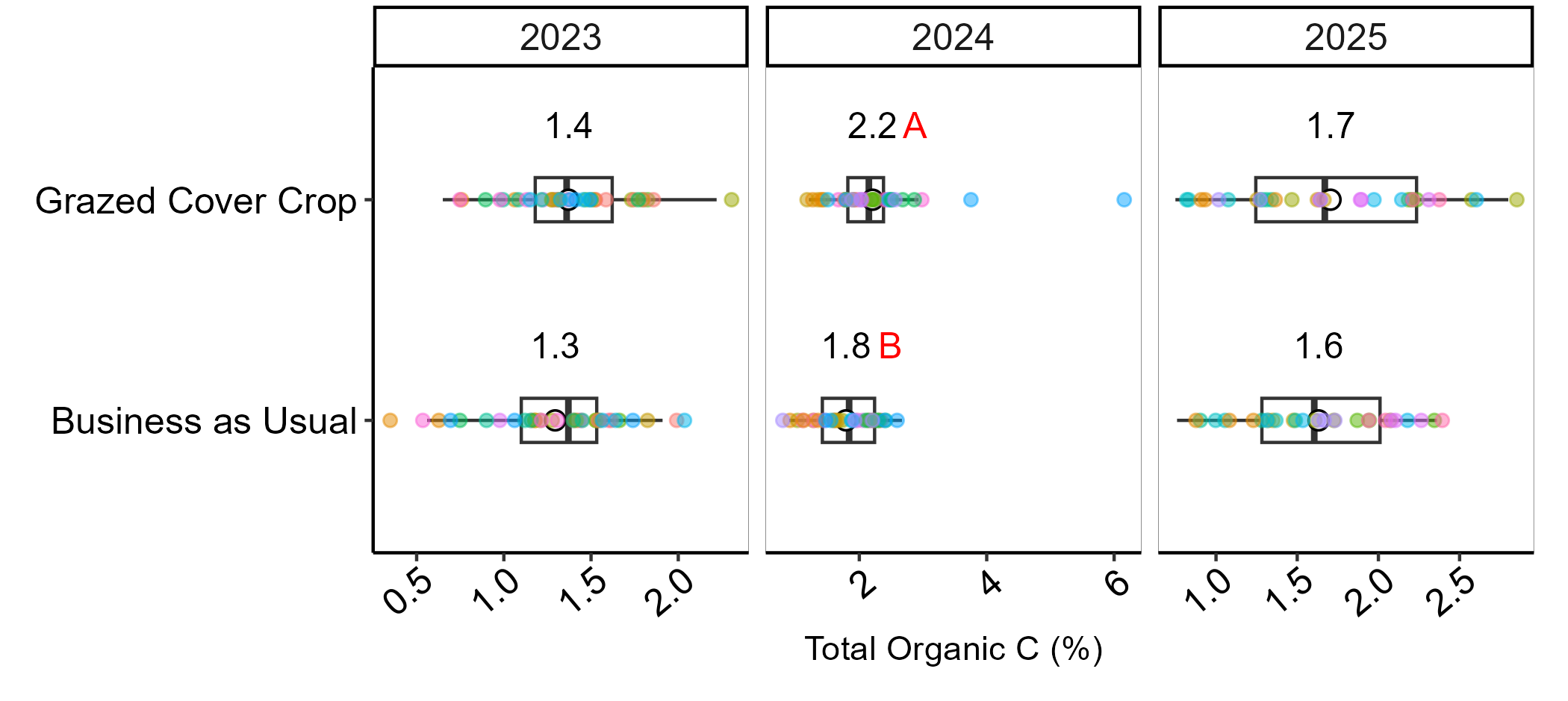
Organic Matter & Soil Organic Carbon (Figures 1 and 2)
Organic matter and soil organic carbon, which are critical for water retention, erosion resistance, and overall soil structure, are showing modest but consistent increases in many cover-cropped fields. These gains are more pronounced in wetter years.
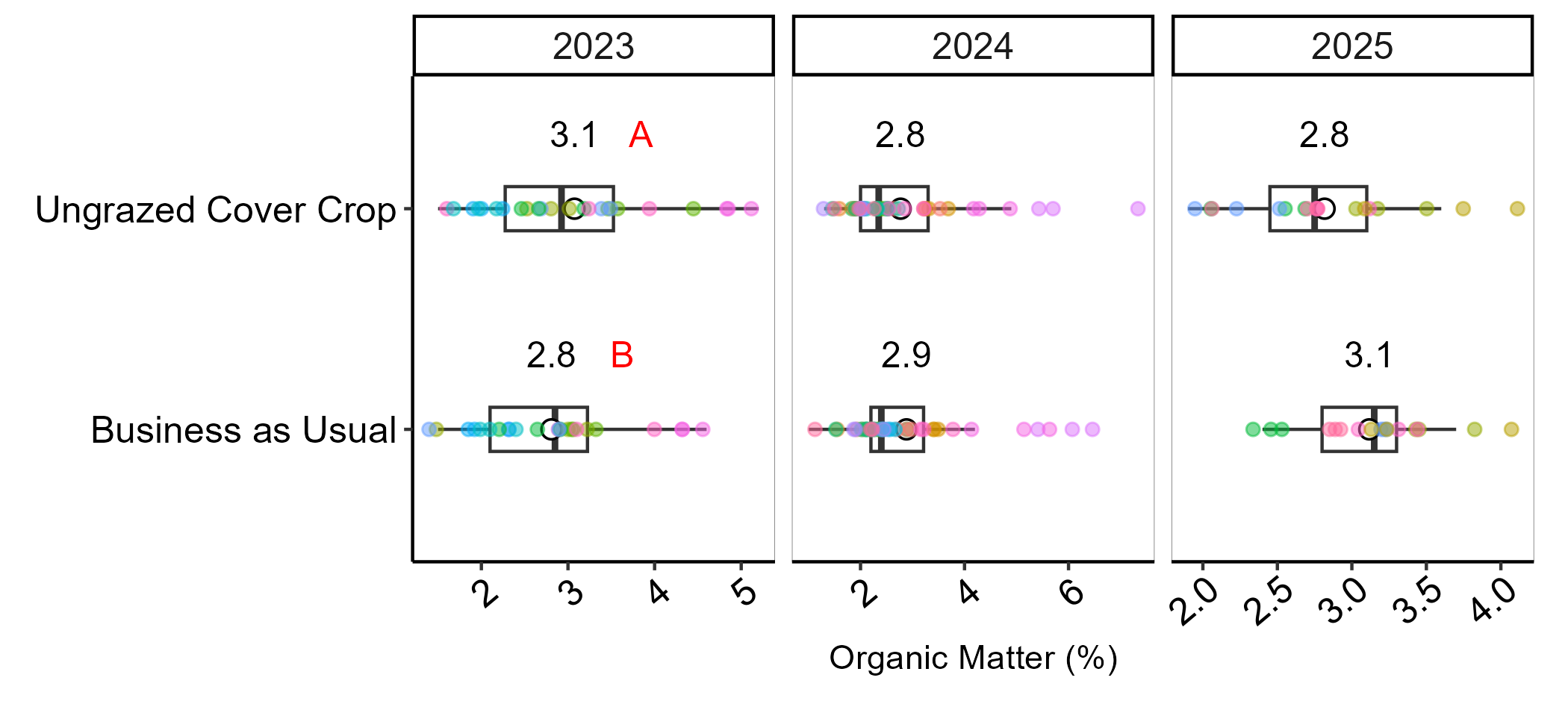
Figure 1. Side-by-side comparisons for each growing season show how organic matter measurements vary by practice. Business as Usual compared to ungrazed (left) and grazed cover crops (right). Colored dots are field samples from different farms; the white dot and number mark the average. Red letters appear only in seasons where the two practices are statistically different (mixed-effects model with farm effects; Holm-adjusted p-value ≤ 0.05).
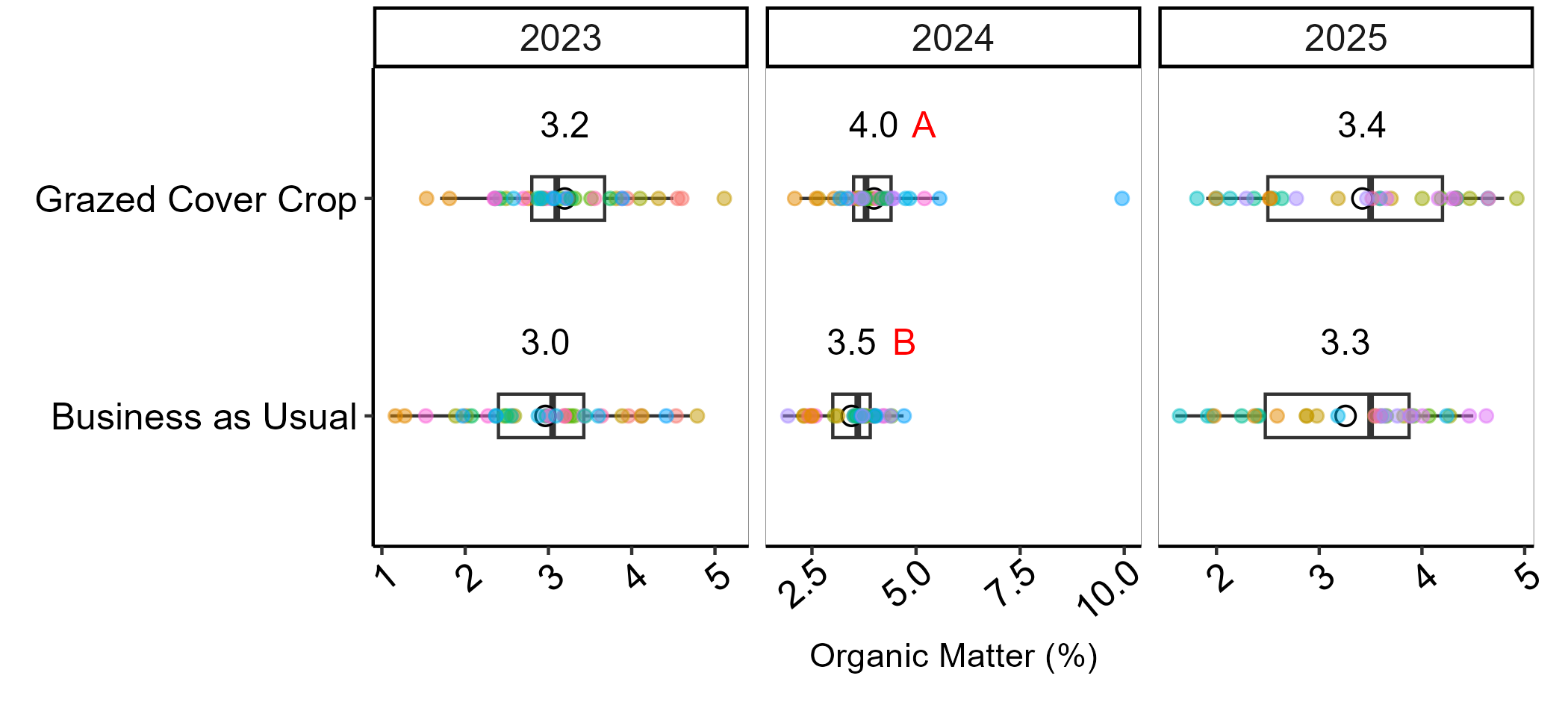
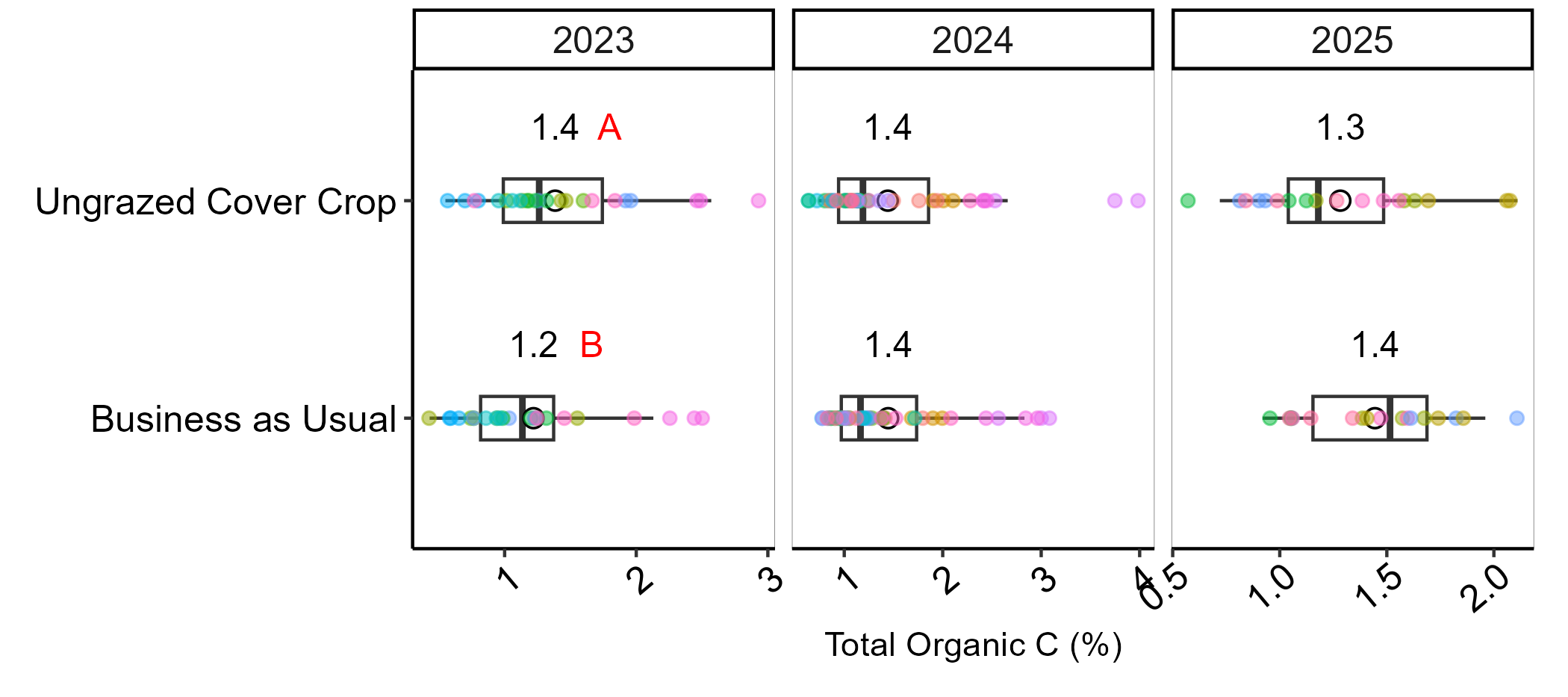
Figure 2. Side-by-side comparisons for each growing season show how soil organic carbon measurements vary by practice. Business as Usual compared to ungrazed (left) and grazed cover crops (right). Colored dots are field samples from different farms; the white dot and number mark the average. Red letters appear only in seasons where the two practices are statistically different (mixed-effects model with farm effects; Holm-adjusted p-value ≤ 0.05).
Soil Respiration (Figure 3)
Soil respiration, a proxy for microbial activity and biological functioning, is trending upward in both grazed and ungrazed cover crop treatments. In some cases, grazed fields show notably higher respiration rates, pointing to potentially enhanced nutrient cycling and residue breakdown.
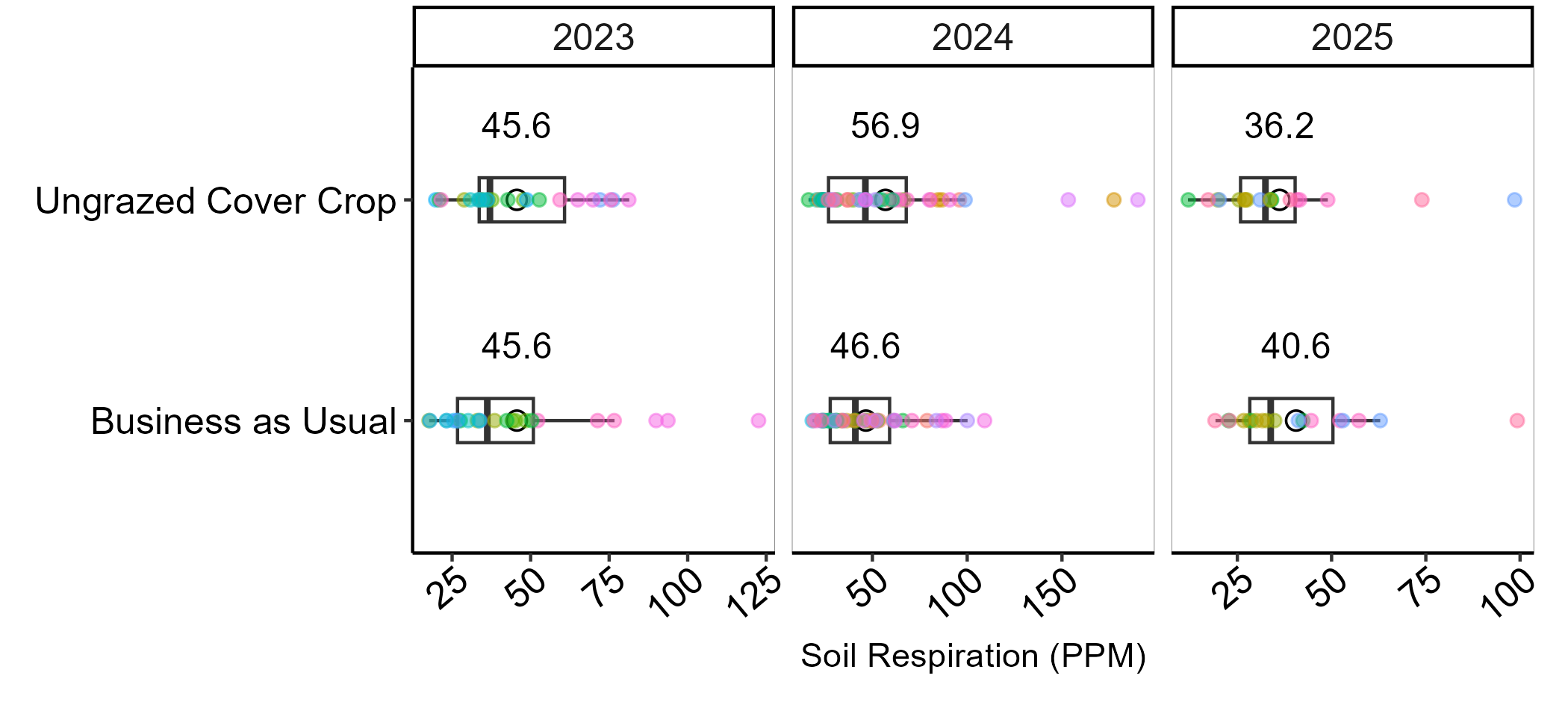
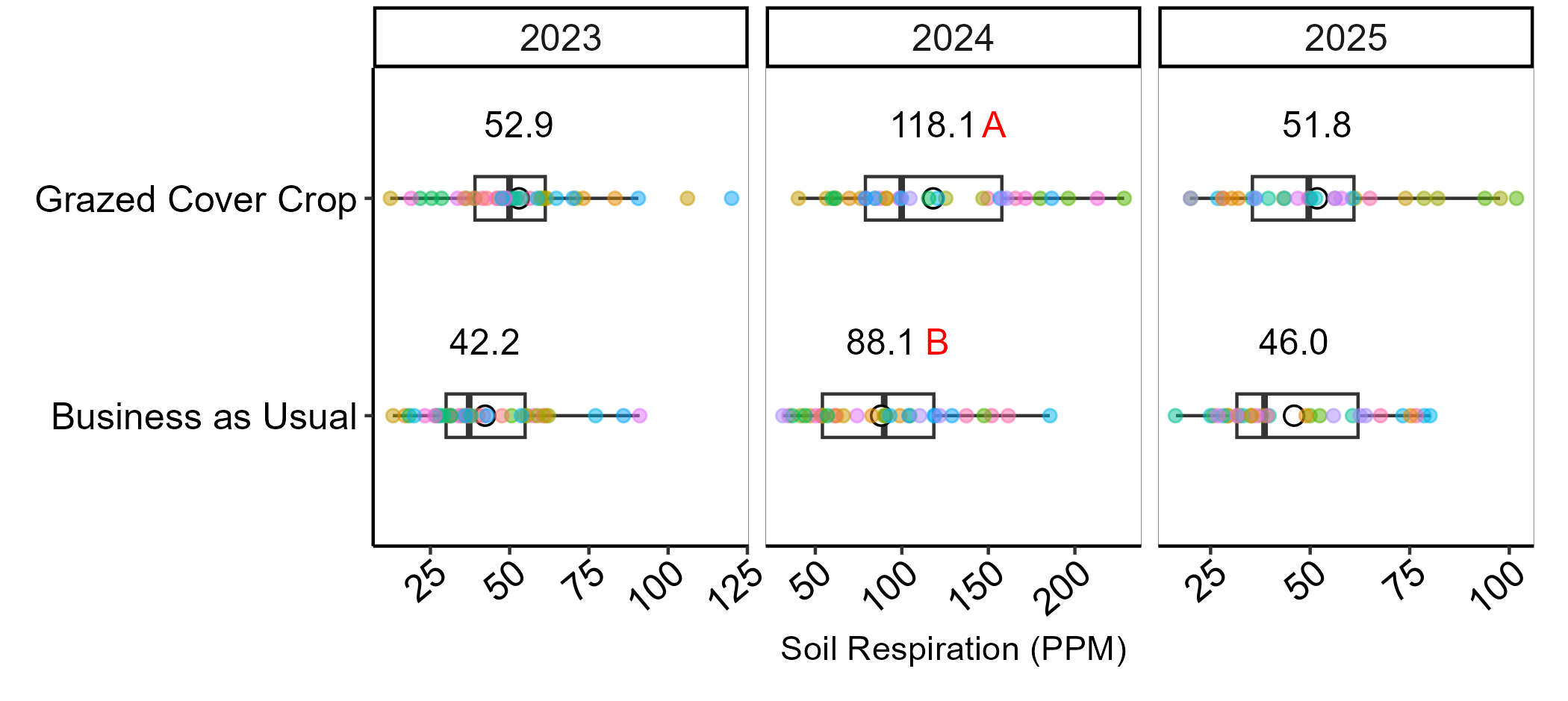
Figure 3. Side-by-side comparisons for each growing season show how soil respiration measurements vary by practice. Business as Usual compared to ungrazed (left) and grazed cover crops (right). Colored dots are field samples from different farms; the white dot and number mark the average. Red letters appear only in seasons where the two practices are statistically different (mixed-effects model with farm effects; Holm-adjusted p-value ≤ 0.05).
Soil pH (Figure 4)
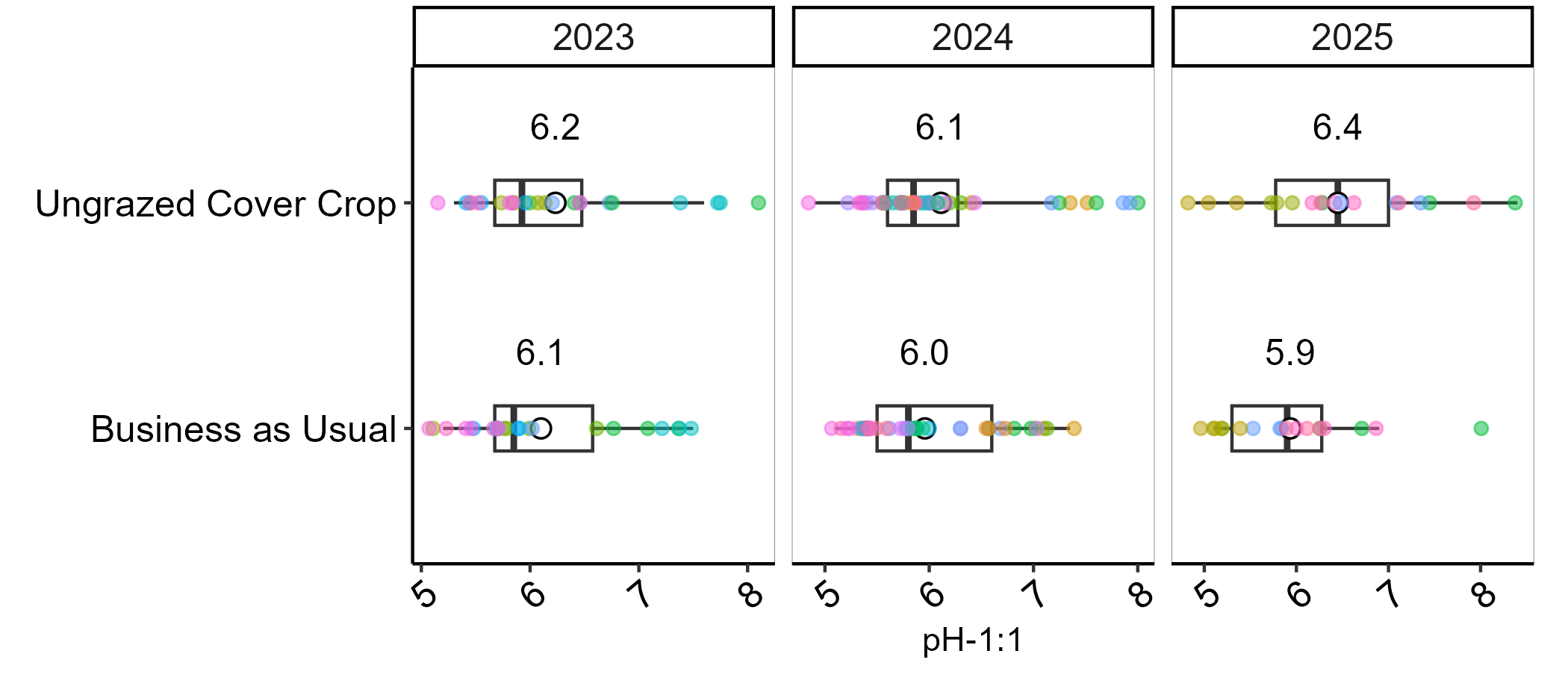
Soil pH is also shifting slightly in a positive direction. While pH tends to change slowly, these incremental increases can improve nutrient availability and root function over time.
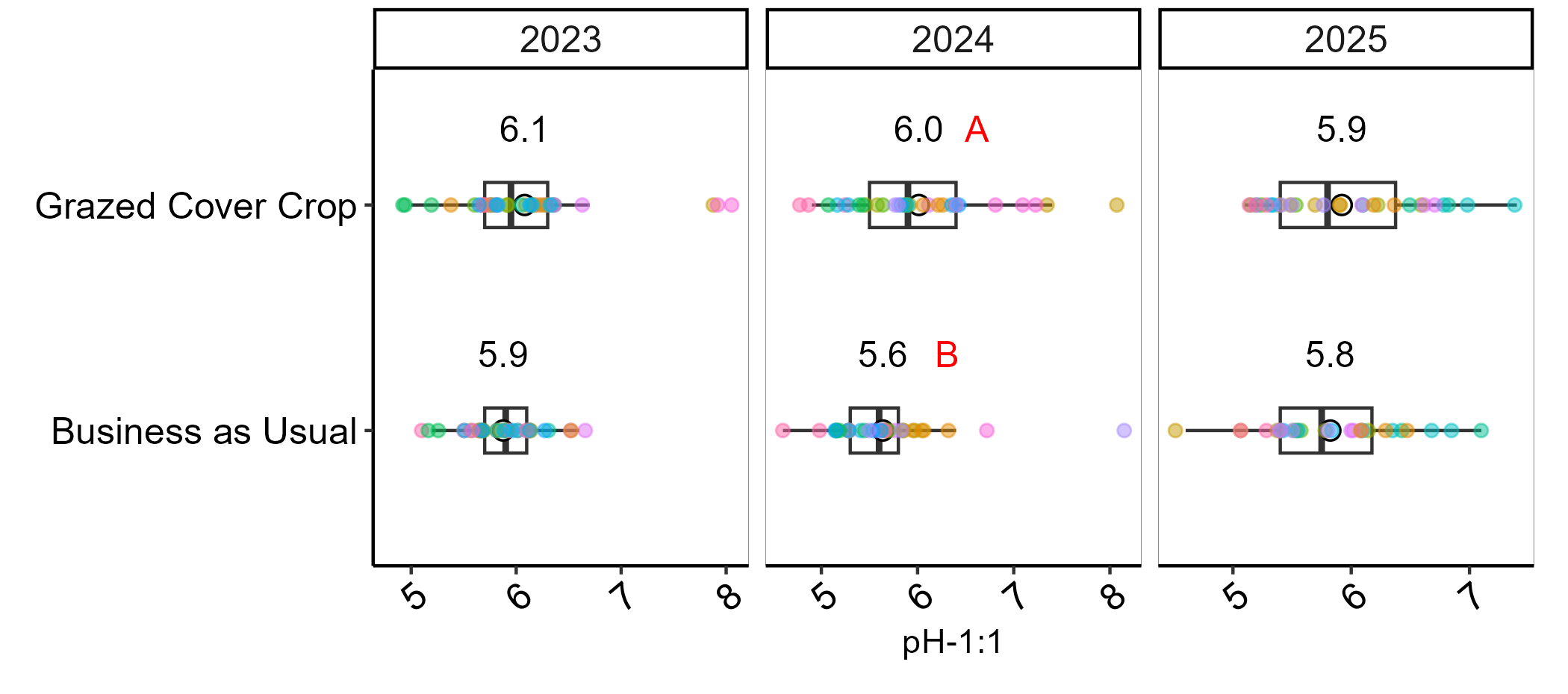
Figure 4. Side-by-side comparisons for each growing season show how pH measurements vary by practice. Business as Usual compared to ungrazed (left) and grazed cover crops (right). Colored dots are field samples from different farms; the white dot and number mark the average. Red letters appear only in seasons where the two practices are statistically different (mixed-effects model with farm effects; Holm-adjusted p-value ≤ 0.05).
Early Insights
Taken together, these findings suggest that cover crops, especially when integrated with grazing, are beginning to improve soil health across a wide range of farm systems. The trends are early but encouraging, pointing toward a gradual, measurable shift in soil function under real-world management conditions. If you have questions about this data, contact Diana Salguero-Gaibor at DianaS@PalouseCD.org.