
Episode 7: Improvements in Soil Biology with Stuart Elliott and Jessiann Loomis
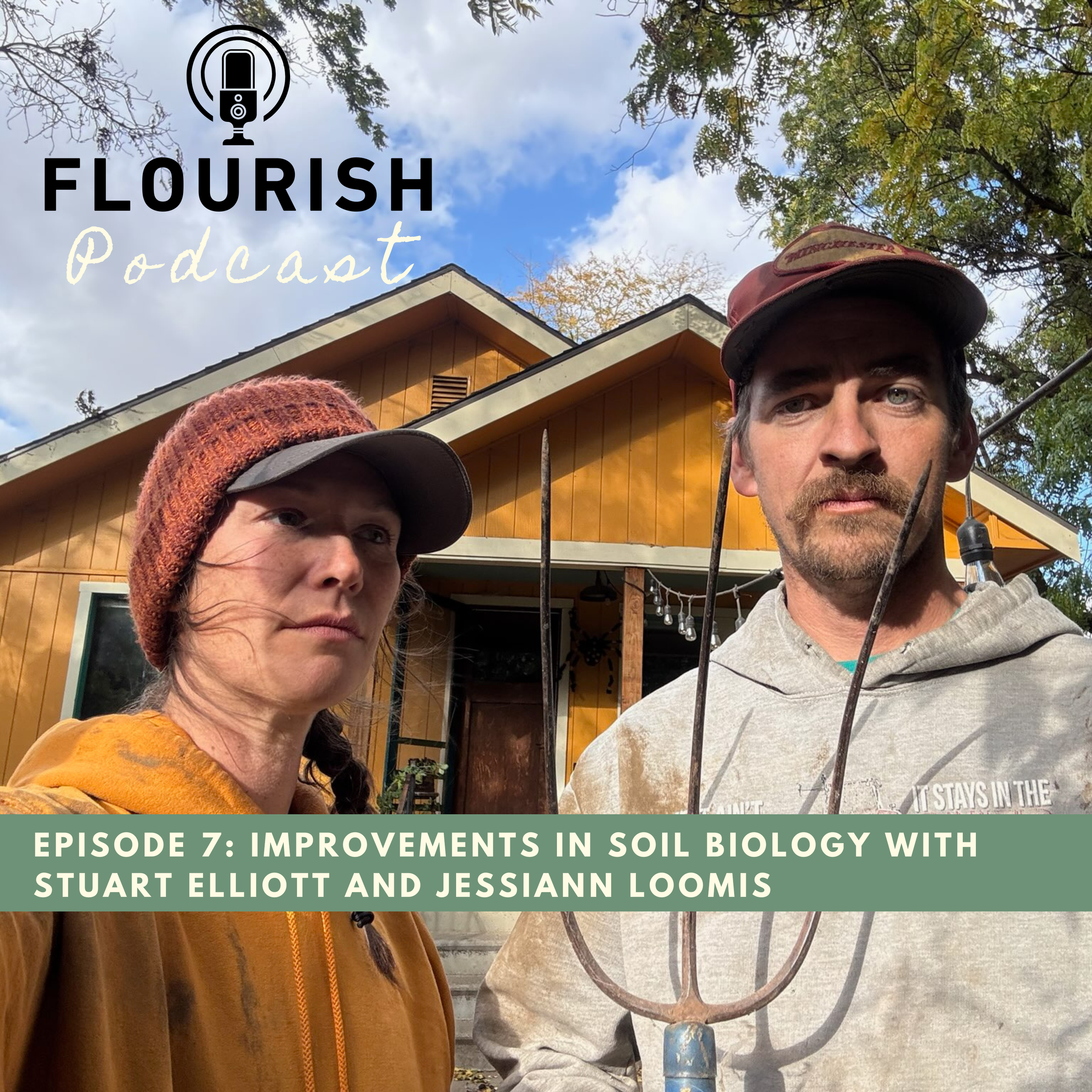
Stuart Elliott and Jessiann Loomis
About the episode:
Join us as we chat with farmers Stuart Elliott and Jessiann Loomis about their usage of cover crops instead of a fallow period, and the changes they found in their soil biology after cover cropping. Stuart and Jessiann share what has worked, what hasn’t, and what they’ve learned along the way.
Stuart and Jessiann are participants in the FLOURISH on-farm trials.
About the podcast:
Welcome to the FLOURISH Podcast, where we at the Palouse Conservation District interview farmers, ranchers, and researchers on topics related to conservation agriculture. FLOURISH, also known as Farmers Leading Our United Revolution in Soil Health, is a farmer-led conservation innovation project to support the widespread adoption of soil health practices by integrating cover crops and livestock into farming operations in the Inland Pacific Northwest. The ambitious purpose of FLOURISH is to not only regenerate our soils, but also our rural communities by creating opportunities for younger generations to return to productive, sustainable farms. On this podcast, we bring you updates from on-farm trials, research, findings, and advice from farmers.
The views and opinions expressed on the FLOURISH Podcast are those of the guests and do not necessarily reflect the official policy or position of Palouse Conservation District or the USDA Conservation Innovation Grants program. Any content provided by our Guests are of their opinion and are not intended to malign any religion, ethnic group, club, organization, company, individual, or anyone or anything.
-
Introduction
Hello, and welcome to the FLOURISH Podcast, where we at the Palouse Conservation District interview farmers, ranchers, and researchers on topics in conservation agriculture. FLOURISH, also known as Farmers Leading Our United Revolution in Soil Health, is a farmer-led conservation innovation project to support the widespread adoption of soil health practices by integrating cover crops and livestock into farming operations. The ambitious purpose of FLOURISH is to not only regenerate our soils, but also our rural communities by creating opportunities for younger generations to return to productive, sustainable farms. On this podcast, we bring you updates from on-farm trials, research findings, and advice from farmers.
Ryan Boylan
All right, welcome back to FLOURISH podcast. I'm here today with Stuart Elliott and Jessiann Loomis with Elloom Farms. Thank you guys for joining us.
Stuart Elliott
Howdy.
Jessiann Loomis
Thanks for having us.
Ryan Boylan
Yeah. We're at the Rock Lake Conservation District office in their boardroom. Beautiful view, downtown St. John. I was wondering if you two could just talk a little bit about your farming operation, like where you farm, how much rain you get, typical crop rotation…
Stuart Elliott
Okay. So we farm west of St. John, Washington, and we get about 16 inches of annual rainfall. And our farm goes from just south of Highway 23, between St. John and Ewan, up into Pine City, Washington. Famous, famous city, Pine City.
Ryan Boylan
How long have you guys been farming?
Stuart Elliott
Um, I came in 2009, to help with harvest, and then we moved here in 2010. So this will be the 15th year of fun in the sun.
Ryan Boylan
Cool. And then Jessiann, you grew up on the farm?
Jessiann Loomis
Yep, I grew up here and went over to college and then came back at the same time as him. Came back together.
Ryan Boylan
That's great. Cool. Is your family still farming?
Jessiann Loomis
Yeah, my dad, this is his first year of full retirement.
Ryan Boylan
No way.
Jessiann Loomis
Yeah.
Ryan Boylan
Good for him.
Stuart Elliott
He still has to come and help, though. Yeah, we rope him into helping. I don't know if he knows how not to work.
Ryan Boylan
(laughs) Yeah. That's good. Great. So yeah, this podcast is all about the FLOURISH trials that we've been doing. And you guys did one FLOURISH trial the first year and then skipped last year. Can you just talk about like why or how you got involved with the project and how it's been going?
Stuart Elliott
Well, I had seen some other cover crop funding available, and it was all very restrictive, and it didn't seem to line up with what needed to happen. And I really liked FLOURISH because it allowed everybody to just be free to do what they wanted and take it where they wanted to go, which, in my opinion, gets a lot more, more data and, and just gets more of the picture. You know, and everything's so different out here, the soil’s so different everywhere, you need everybody you can get to pull every idea they think out of the hat, and you see what works and what doesn't. And so I think it's been excellent.
Ryan Boylan
Yeah, that's good. What, um, what was like sort of your motivation for trying cover crops?
Stuart Elliott
Well, we go to all the Kool-Aid conferences, and I'm just learning about soil microbiology and trying to do something better for it other than planting the same thing over and over.
And it seems like a shame we've come so far in protecting soil erosion, but we've kind of created a new problem with fallow because it's, you know, just you keep it dead. And if you believe that there's things under the ground, which I think is fact at this point, you’ve got to have some kind of environment that they can live in. And if you take everything away, they don't have a lot left, you know, to thrive. And those, everything down in there is what can take care of your plant and keep it healthy and keep disease back and and make bad ground better.
Ryan Boylan
Yeah.
Jessiann Loomis
We figure the last, you know, generations of farming, they did an amazing job with the information they have. And they were always making progress. And like my dad was always doing what he saw best for the land and trying to do better than what was done before.
And now we have a lot of, a lot of science and information that the past generation of farming didn't have. And so I think it's our opportunity to make use of that.
Ryan Boylan
Yeah. It's funny, we talked about this in the last podcast I did, too. But it seems like there's a movement similar to the direct seed movement, maybe in the 70s, that's happening with like regenerative, whatever you want to call it, like, that's happening now, with like younger farmers and older farmers alike. And I wonder if those are like the same or different. I mean, this one feels a little different. There's more social media involved.
Stuart Elliott
I think it's it's very similar, because there's going to be a lot of struggles. And anybody that's going to push the envelope and try something new has to expect to kind of fall on their face. And you come in with ideas and you know, you think it's going to be great, and it's going to solve everything. And you just learn more and more. And the hard thing with farming is it takes so long to try anything and to find out if it was good or if it was bad for you.
Ryan Boylan
Yeah.
Stuart Elliott
And so far what I think with the cover cropping is I think that it is very good for your soil. And it's a long term, you know, investment of an action. And I don't think there's going to be a whole lot of short term benefits. And I think that happened — I saw that with direct seeding as well, where there's people that tried it one year and, and didn't get good results and just threw it in the garbage. And, you know, I've watched over the over a decade of us direct seeding, watching bad ground get better and seeing those benefits and watching the soil at least have a chance to rebuild itself. And so I think we're going to have to walk the same road. And it's not going to be something that's going to make you a bunch of money right out the gate.
But I think we need to think as farmers is how we're going to, how we're going to protect our ground, because that's, that's what's most important. If our ground’s not healthy, we're not going to be able to do this for much longer.
Ryan Boylan
Yeah.
Jessiann Loomis
That's been the interesting thing with that cover crop, it's on the road, everybody sees it. People, people ask, you know, oh, after the first year, you know, tell me, tell me how it turned out, let us know how it turned out. And it's like, well, we're not doing this for a one year turnaround, you know, talk to me, you know, six years down the road, and we'll, we'll talk about the changes that we've seen.
Ryan Boylan
Yeah, I think it's, yeah, I know, it's like another tool, right, in the toolbox. I feel like in the beginning, maybe it was people thought that cover crops were just going to like fix your soil. But that's not the only thing. There's like plenty of others.
Did you guys see anything in the — so how did the crop rotation work with the cover crop that you seeded?
Stuart Elliott
Well, our rotation, we have a three year rotation. So we do a full year winter wheat crop, and then a spring crop — a half year crop — and then a full fallow period. So instead of that fallow period, we went out there and just punched a whole bunch of seed into the ground, and let it grow up, and didn't have to spray it and then went out there and kept it mowed down so it wouldn't go to seed and held onto it as long as we could. And it was, it was nice to see that green out there. I mean, there's a part of you that sees that and it just feels right.
Ryan Boylan
And so you mowed into it? And then did you end up spraying it out at the end?
Stuart Elliott
Yes, after…I think I sprayed it out in July, in early July. Um, but it's amazing. I mowed it the first time when we left on like a 10-day vacation, and I got back planning on spraying it out, and it had all grown back, different things had grown up and gotten big. And I thought, Wow, it's time to mow this again. Which was good to see all that.
And the reality of it is to grow those plants, you are using up the precious moisture that we get. We don't get a lot of moisture in those times of year. And so, you know, we like to think that, you know, I've seen some trials have come out saying that you're not going to use any more water between that and fallow. But unfortunately, it does take water to grow plants. But I think we have to look at the long term benefit to what you're doing in your soil, and just take that hit.
Ryan Boylan
So the cover crop was followed with winter wheat?
Stuart Elliott
Yes, and we came back in and seeded that in this following late September.
Ryan Boylan
Was there like a yield drag or…?
Stuart Elliott
Absolutely. Oh yeah.
Jessiann Loomis
Yeah, you have to treat it like basically a re-crop. You know, that's kind of well known around here that when you do re-crop, you're going to take a hit on your yield.
Stuart Elliott
Unless you get lucky with the rain, yeah.
Jessiann Loomis
Yeah, and we knew it was going to. What we're doing this for, though, is we are specifically monitoring and trying to increase the soil biology. And so with that fallow period, you've got this huge period of time where you're not feeding that biology at all.
And we're trying to increase the diversity of plants that we have, which cover cropping does, and then feed that biology, which the plants do. And we're hoping, and this is where you, there are the theoreticals and you see if you can make it work in practical, you know, the practical world.
We're hoping that if we continue to do things that create a good habitat and heal our soil, that we can get a really good functioning soil and it will have the ability to retain moisture much better because we have large drought periods. And so that having the cover crop out there won't be such a yield hit. And, you know, the years where we do have just really poor timed rains, our soil’s in better condition to feed the plants.
That's ultimately what we're trying to see if we can make it work out because, you know, that's theoretically how things should work. And we'll see if practically, if it will work that way. It's hard to know unless you try it.
Ryan Boylan
Yeah, and that could take…a long time.
Jessiann Loomis
Yeah, this is a decade project.
Stuart Elliott
Well, and the reason why we didn't do a cover crop last year is because we couldn't convince any of our landlords to let us do it. One of those landlords is her dad…
Jessiann Loomis
So we've just got one piece of ground we're going all in on. Instead of moving it around, we just got this one piece of ground and we're going all in on it.
Ryan Boylan
Which I think that's a cool way to do it because then you can like track to see what happens like over time versus like bouncing it around to different fields.
Jessiann Loomis
And I really, I'm not sure, I'm not convinced that just doing it once or twice is going to really do much benefit. That's why we have it in this one spot. And we've kind of changed multiple farming practices to go along with it all to line up with creating a better environment for the biology.
Ryan Boylan
That's cool. Did you guys fertilize the cover crops?
Stuart Elliott
No, we didn't. But I know that my buddy, Doug Schuster, was doing that. And he — I think if you can, if you can get more growth out of it, like he was managing to do, if you can get a really healthy stand, then you've got a better chance of keeping things you don't want from growing in there. So I might consider that but this gal sitting next to me, she's kind of against fertilizers. So I don't know how much, how far I'll get with that.
Ryan Boylan
Well, so you go ahead if you want.
Jessiann Loomis
I was gonna say, not, you know, that advanced soil health day up in you know, that was really, really interesting to me. And I think there's more to learn about integrating some of that. You know, that was…I loved that day up in, down in Kennewick, over…
Ryan Boylan
The guy — Neil Appel was the person we interviewed right before you guys last week or two weeks ago or something. And he fertilized his cover crops with something gold. I can't remember the name of the product. It doesn't really matter. But it's just like chicken manure. And he didn't see as big of like a yield hit the following crop. But it could have been because of the weather. Like I think he said he got rain. But the other interesting thing is like the, the yield hit or like the re-crop scenario. They see the same thing like in Moscow and like east of Moscow. Like something after cover crops, like does something to the next crop. And it usually hurts the yield in some way.
Stuart Elliott
Interesting. And they do continuous cropping, as well. I'd be…I’m surprised to hear that.
Ryan Boylan
Yeah, I know, and like I hadn't thought about it. We had a meeting with a bunch of…there's another project. It's like a Western SARE….it's called PANDAS. But they're essentially doing these cover crop trials, really small plots like the Ericksons have one, Doug has one. And then there's two over there.
And they're seeing the same like yield, which is yeah. And one of the theories, like my partner, Kendall, she's a soil scientist at U of I, and she thinks it's just like the carbon to nitrogen ratio. I probably shouldn't say that on air. (laughs)
Stuart Elliott
So not, not as much carbon coming back from the crop?
Ryan Boylan
Or too much. Yeah, like higher carbon, higher carbon and less nitrogen.
Stuart Elliott
—or higher carbon and depleting nitrogen.
Jessiann Loomis
Which could potentially have something to do with the lack of biology already there in the soil, because that's what would be consuming that carbon and keeping things in balance a bit more.
Ryan Boylan
Yeah. I mean, you guys are in a different scenario, like as far as precip goes too. So I don't know. It's just, yeah, it's, it's just, it's cool to see what's happening all over the place.
Stuart Elliott
It's nice to have a piece of ground that we can just throw this stuff at and not really care about making the money. Because the reality on the rest of the farm is, is it's margins are tight, you know, and you can't really afford to step out of place with any of the components and it only takes one mistake to, for things to fall on their face.
So I really feel that pressure to make sure I can keep the rest of the farm as productive as possible. And as of now, that includes synthetic inputs and, and foliar spraying. And trying to keep things as clean and as straight as possible. And so we can keep the farm open.
You know, that's rule number one, don't lose the farm. So if we can work on this field over a few years and we can start to see some improvements and can come up with a game plan and get it all square, then hopefully we can move it on the other fields and have an idea on how to do it right the first time.
Ryan Boylan
Yeah, it's, going back to what you're saying, like, it's a 10-year trial. I don't know. And maybe you won't see like any return on investment until the fifth or…
Stuart Elliott
Well, in 10 years, you're only talking about three rounds of it.
Ryan Boylan
Yeah, I know. I know. It's crazy.
Stuart Elliott
Yeah. But I mean, it is the same way with direct seeding, just watching what happens if you don't completely pulverize your soil. It takes several years. And it's not profitable out the gate. But now there's no way I'd go back.
Ryan Boylan
Yeah, that's cool. Yeah. Back to — can we go back to the cover? Did you end up having conversations with any of your landlords? If you want to talk about this?
Stuart Elliott
Oh, well, my, my in-laws are about a third of what I farm. They're the landlords and we chatted with them and they're interested, and they’re, and they want to check it out. You know, and it's, it's funny because I got my father in law who taught me how to farm and, and brilliant man. And he's just like, no way. There's no way this is gonna work out.
And to be to be honest, everything he said would happen to me happened exactly. Yeah, but and then her mom's the other way. She's a bleeding heart, and she loves everything environmental. And she's like, I don't care. You know, we're gonna do it anyways, because it's the right thing to do. And she doesn't want us to use chemicals or anything.
And so, you know, it's kind of similar to relationship Jessiann and I have. You know, she's the dreamer and I'm the dream killer. But, you know, we chatted with them. And it's, it's tough, you know, to take out a section of ground and you know, because, you know, dealing with crop insurance, you're working with a 10 year average.
So if you start dropping that average down, it only takes a few years and and yeah, you're in trouble. And so you have to play it safe. And then our other landlord, we have two other landlords. And I just, I'm kind of new farming their ground. And I just don't want to make any mistakes. But I think in the future, I can, you know, our landlord down here at Shane Farms, he's really interested in trying to do what's best for his ground and making sure that his ground is, is, is cared for. So I could see him being into that. But you know, when we picked that ground up, it was not in great shape. And it just in the past few years, I feel like it's it's improved quite a bit.
Ryan Boylan
That's cool.
Stuart Elliott
But yeah, it was, it was pretty heavily conventionally tilled. And there's a lot of acres that I'm hoping will come back.
Jessiann Loomis
We've got to prove some things out for ourselves before we start talking to our landlords about using their ground. I don't know what we would do if we didn't have a piece of ground that didn't have a landlord on it, that would be a much tougher decision to make. And that's where the FLOURISH program does help is that, you know, if you can help it not hurt your landlord quite as much…
Ryan Boylan
Yeah, like offset the risk.
Stuart Elliott
Yeah, it's a, it's a tricky game.
Ryan Boylan
Yeah, I think about this a lot too. It's like, oh, why doesn't everybody just cover crop? It's like so complicated.
Jessiann Loomis
It is.
Ryan Boylan
Do you guys remember what was in that mix that you seeded?
Stuart Elliott
Oh, I got a picture of it here somewhere. But, we could probably top of the head it. You go for it. I'll look for the picture while you talk.
Ryan Boylan
Was it like more than 10?
Jessiann Loomis
Um, had to been right around there. Because I think that we did, I think we had a mix blended of like eight things or something like that. And then we got some barley and peas locally that we kind of used for the bulk.
Ryan Boylan
Oh, cool.
Jessiann Loomis
Yeah. Actually, it's ended up being about a third. We did a third of the peas, third barley, and then a third of the extra mix.
Ryan Boylan
Oh, nice.
Jessiann Loomis
Yeah. Yeah. We came up with that because there's a tool online. Some cover crop company, I don't think it's anywhere local at all. But you can go onto their website and you can put in your target carbon to nitrogen ratio. And then it has all the plants, plants broke down by species and things like that. And you try to get an even blend. And so then I was able to take that, that we kind of mapped out and go to a local seed company and see what they had that crossed over there.
Ryan Boylan
Was that Green Cover? Do you remember?
Jessiann Loomis
I think it was.
Ryan Boylan
Yeah, I think they're out in Nebraska, maybe.
Jessiann Loomis
Okay, yeah, I knew it wasn't really feasible, but it's a good tool to use.
Ryan Boylan
Yeah, totally, yeah, yeah.
Stuart Elliott
Okay, here's what it was. It was Gunnar triticale, flax, Piper sudangrass, sun hemp, black oil sunflowers, anaconda radish, balansa clover, forage rape. And then we mixed in a bunch of peas and a bunch of barley.
Ryan Boylan
Cool. Do you guys think you'll do the same thing?
Stuart Elliott
I think so. Yes. And we're gonna up the seed rate, I think, a bit just to see…not that it was thin, but just to make sure we have a solid population.
Ryan Boylan
Yeah, cool.
Jessiann Loomis
I think what we could have done better, and we'd like to do better this time, is maybe going out and actually identifying what plants really thrived and were worth putting in there. But it was, since we did it on such a large area, up in the hills in kind of a medium range flat and in a really good flat, I think it varied depending on where you were, what was really the strongest.
Stuart Elliott
Yeah, different things grew better in different places. And it was actually amazing. Some of the ground, there's some ground up there that is inches deep, just terrible and can't hardly grow a wheat crop. And it managed to grow up and be green and have certain things that wanted to grow in it and stick in there. And I can't help but feel like that's got to be good for it. But yeah, I mean, I kind of have a problem with test plots in general, when they go find a flat in a field somewhere, and put it out there and then give you all the information like that's going to work over every acre of ground.
And so Jessiann was like, well, we're just going to do the whole thing. So we did 240 acres of the cover crop.
Ryan Boylan
Oh, you did? That's awesome.
Stuart Elliott
We did the whole piece. Yeah. And so it was really cool to go out there with the mower and just look at where it was good and where it wasn't and places where some strange things were happening. And then I had a whole bunch of oats growing up in one area of the field. And so I think I'm, as terrible as it sounds, I might have to add spraying it with oat spray, which is like 15 bucks an acre. So that's not fun. But yeah, you can't let oats go to seed in your field. Because that's years and years of backtracking.
Ryan Boylan
Yeah. So we talked about this before we got on air, or started recording, but you guys were going to maybe integrate livestock, but then didn't end up doing that.
Stuart Elliott
Yeah, we had, I got a neighbor near me that that has, had cows. I don't think he has cows now, but I don't know. But he runs his cows kind of through there. So I thought it'd be it'd be easy for him to pop them in there. And he planned on doing it, but it didn't end up happening. So yeah, we didn't, we didn't do that.
Jessiann Loomis
What we did instead was kept it mowed to kind of mimic the grazing. And we also added biology manually rather than, you know, the cow pies. To kind of mitigate that.
Ryan Boylan
Oh, that's cool.
Stuart Elliott
Sprayed that beforehand, right?
Jessiann Loomis
We sprayed it right before we seeded, right? And then we seeded into it the next day. And yeah, we sprayed some biology and some food for the biology.
Ryan Boylan
Like molasses or something?
Jessiann Loomis
Um, well, we did the kind of fish hydrolysate type stuff.
Stuart Elliott
Awful.
Jessiann Loomis
Yeah, I almost lost him on that one. (laughs)
Stuart Elliott
She was out cleaning the tips and was putting them in her mouth to blow on them. I was like, ugh, I would be puking immediately.
Jessiann Loomis
It was the only way to do it.
Stuart Elliott
I was in the cab and it almost made me puke just watching that.
Jessiann Loomis
I mean, there, I should have brought a list of what we put down. There was more than just that, that, some humic acid probably. I'm not exactly sure.
Stuart Elliott
HumaCarb was what it was called from AEA.
Jessiann Loomis
Two years since we've done that. Yeah, I can't quite remember off the top of my head. And really, you know, that's the thing is —
Stuart Elliott
I think we did do it. We did a whole bunch of molasses too. I remember that, I remember dumping all those five gallon buckets through a screen.
Jessiann Loomis
That would make sense.
Stuart Elliott
Yeah, that was fun.
Ryan Boylan
Did that gunk up the nozzles?
Stuart Elliott
That didn't so much. But the takeaway is definitely any of these products you buy, you want to pour them through a screen. Because they cause trouble.
Jessiann Loomis
And then also, we should have cleaned the filter on the sprayer while we were doing it because we started at the end having some issues. And when we cleaned the filter afterwards, it's like, oh, there were our issues right there. Yeah. But we used like drip nozzles rather than…
Stuart Elliott
Yes, that's how we did that, wasn't it?
Jessiann Loomis
Yeah, the stream nozzles rather than, or the drip nozzles. I don't know what you call them.
Stuart Elliott
Stream nozzles. Yeah.
Ryan Boylan
Do you think there is a place for livestock? Like, I'm just thinking about the, the amount of money it takes to buy a cover crop. And it's just, you're just doing it for the soil. So you're not making any money off of it. It's, I mean, I know it's not for everyone either, but…
Stuart Elliott
Yeah, um, that's a tough question to answer.
Jessiann Loomis
Yeah, you have to, if you yourself aren't a cattle farmer, which we're not —
Stuart Elliott
Thank God.
Jessiann Loomis
With the farming we do, I think that we're probably fully stretched far enough that cattle is not really an option for us.
Stuart Elliott
But we got neighbors with cows.
Jessiann Loomis
We do. But having a piece of ground that's not fenced in is, you know, 240 acres, that's a lot of work for them to put cows out there. Not saying it's not doable. It just logistically was easier for us to do that. And, you know, the way I'm looking at it is I am feeding livestock, but they're the biology. That's really, that's really our goal here. That's what we focus on.
I do soil tests to, you know, make sure I've got or see who we have there. And it will be interesting now, after we've been through, we had the cover crop, we had our, our crop go in. And going into this winter, we still had some biology that we did not have at the start of this in the ground, which was exciting to see because, you know, they're just kind of left out there.
I would have loved to do something for them over the winter for food. It didn't end up working out. But we will do it in the spring. It will be interesting to see who's left over in the spring. And we want to get, we would want to be able to add biology, you know, when they do take those hard hits to be able to add some biology back to the soil. I just want to see what happens when we get a good, full community of biology in our soil doing all the work it's supposed to do.
Ryan Boylan
That's cool. So are you, you're sampling every spring or not?
Jessiann Loomis
Actually, just throughout the year. But it's, I have a microscope at home. So I just do it myself. I just go out there and, and take some soil and go home and see if I, what I can find.
Ryan Boylan
Nice, that's cool.
Stuart Elliott
It was one day she texted me out and I was in the field doing something and she had found some larger bug in there.
Jessiann Loomis
Might have been the micro arthropod.
Stuart Elliott
Yeah.
Jessiann Loomis
Yeah, you still can't see it.
Stuart Elliott
But it's a sign that you've got more of a balanced system. You've got not just the really tiny bacteria that we have in all the soil around here, but the predators that come from that.
Ryan Boylan
Yeah, that's cool.
Jessiann Loomis
Yeah, yeah, it's been pretty cool to see. Because before we started doing this, I kind of went around and first sampled several of our fields that we feel like we've treated very well.
And there's nothing but bacteria there and bacteria is great, but there's also not a big diversity of the bacteria in there. And so I started kind of maybe going to other people's fields and things and checking it out. I couldn't find anything anywhere. And so when we started doing this, since then, I've found, I’ve found a lot of really exciting stuff.
Ryan Boylan
That's cool.
Jessiann Loomis
Yeah. And it's just that one time of cover cropping, but not in the quantities we need. It's really small, we still need to repair the soil enough that we can get a good, a good amount of all the biology in there.
Ryan Boylan
Yeah, that's crazy. Are you getting pretty good at identifying them?
Jessiann Loomis
Yeah.
Ryan Boylan
Yeah, that's awesome. That's great. And then we talked about this a little bit too, but you're doing a composting program. Could you talk about that?
Jessiann Loomis
Yeah. So the, the compost is, you know, working to build a specific recipe of local items like hay and, and things like that, to get the native biology from this area, because anything that you get in the jug is pretty much from the Midwest. It's not, it's not local.
And, and so coming up with a recipe that gets the right balance of what you're looking for, the bacteria and all of its predators right there in one thing, and then I'll be able to extract that off and spray it onto the fields. And that's going to be interesting to see if I can scale it up, even just to our 240 acre, but we're gonna see if we can do that.
Because I'd love to be able to have that just part of our, you know, spring program or fall program or...
Ryan Boylan
Yeah, that's cool. And that would just be making like a tea?
Jessiann Loomis
Kind of an extract, it’s just pulling the biology out of the compost itself so that you can spray it on the ground. Yeah.
Stuart Elliott
And can't you, if you have a sample of that, can't you make a tea and then grow that population?
Jessiann Loomis
So if you take the extract and you feed it, then it becomes a tea and it increases the population there.
Ryan Boylan
That's awesome.
Jessiann Loomis
Yep.
Stuart Elliott
We actually ended up finding a guy up in Spokane that worked on an orchard and was making his own compost teas and applying them on the trees. And he was able to make us up what, for him, was a really big batch, and it was a tote of compost tea. And we ended up spraying that out in the field.
I don't know how we feel about how it turned out, but...
Ryan Boylan
Could you see anything, like, in the field?
Jessiann Loomis
I think it, I think he wasn't really lined up to make it in that kind of a batch. And I think that it had kind of gone anaerobic a little bit and actually caused maybe a little bit of harm, which is something to be aware of, anybody who's thinking about that. I didn't look at it under the microscope until after we'd sprayed it, because we're trying to get it done so fast.
It was bring it down, get it sprayed right away.
Stuart Elliott
No shelf life.
Jessiann Loomis
And I looked at it afterwards in the microscope and I was like, oh, no. I don't think this was a great idea.
Ryan Boylan
That's cool. Yeah, that'll be interesting to see how that turns out.
Jessiann Loomis
Well, that one, you know, it definitely yellowed up some leaves. That one was not great, but that's okay. We'll come back from that one.
Ryan Boylan
I do think it's cool. We've been talking about this a lot, too, using things from here versus importing jugs from the Midwest. And I think there is like maybe a market or maybe not a market, but like people, you're also just adding something else to do, which is hard.
Jessiann Loomis
I would love if I could just buy, if somebody here was set up to just be making that and we could just put in our order and go get it and then spray it. You don't want to add a bunch more work, but there's no other option. Even semi-locally, I don't know anybody that we could work that out with.
Stuart Elliott
That's the kind of the tough thing about doing trials and things is, it's hard to set everything up and get everything going to do something small, you know, it's the kind of seems to be the hard thing is getting things out and putting things away and getting things going in the first place.
Jessiann Loomis
Building a piece of equipment for something you've never done before.
Ryan Boylan
Yeah.
Stuart Elliott
So it's quite a bit of effort to try to add something like this to the list of, we're already spread pretty thin, you know, too many acres.
Ryan Boylan
Yeah, that's good.
Stuart Elliott
But I think it's worth doing.
Ryan Boylan
Yeah. You guys mentioned this earlier and it made me think of like every farm sort of has a different goal. And one of the goals of the FLOURISH program was to just like connect all the people that are trying things. And so, just for the people that are listening, we had a meeting in November. We had this whole agenda built out. Each farmer was going to be given five minutes to talk. And it took us six hours to go through 20 people. (laughs) Yeah, you were there.
But it's just, it's very interesting to see how everybody does things like slightly different and what you, like, little bits of info you can pull.
Stuart Elliott
That's how farming…I moved here and started farming. I thought, okay, learn how to do it. And then we'll just do that again. And there have not been two years the same. And everybody's trying something different. And if you're not trying something different, then I don't think, you know, you're not in the right place to be farming because that's what it's all about. You're always trying to make observations and make your best choice. And it's always different. And the weather's always different. I wish it was always the same. That would take a lot of pressure off.
Jessiann Loomis
What fun would that be? (laughs)
Ryan Boylan
(laughs) So boring.
Stuart Elliott
Nothing boring about farming, I’ll tell you that.
Ryan Boylan
Yeah, one of the hardest jobs. Along the same line of getting little bits and pieces from all the people that are participating in the program. Do you guys feel like there's a group of folks out here that you can bounce ideas off of?
Stuart Elliott
Absolutely. We've got quite a few people that are getting into this stuff here. And everybody thinks that they're crazy. But that's the way to do it. As long as you're not losing the farm.
Jessiann Loomis
The FLOURISH program, though, is a great place for that because it's, everybody is taking the information they have. And there is no roadmap here. And it is like, okay, well, how are we going to start applying these things? And you sit down with people and you kind of come up with your best laid plan. And if you have different groups of people doing that, then we all come to the table and share what has worked and what hasn't worked.
And I love the FLOURISH meetings for that, because then you can sit down, you're going to ask them, oh, well, what about this and that? It's wonderful. It's like getting to do extra trials that you didn't do.
Ryan Boylan
It's also cool, I don't feel like anybody's like pushing ideas either. You know what I mean? Like you were talking about the Kool-Aid meetings, which is really funny. And sometimes it does feel like that. They're all always great. Like, again, you pull like bits of information, but I don't know. Just a couple more questions.
So do you guys, it seems like, I asked everybody this, it seems like research from the land-grant universities like WSU, U of I, whatever, are always like 10 steps behind where farmers want to go. Like if you were going to give, if somebody came, a researcher came to you and asked like, oh, what would you like me to look at? Like, do you have any ideas of what?
Stuart Elliott
Well, the tricky part is, is to, to be a researcher and a scientist, you can't really also be a farmer. So it's tough because they're looking at the problems that we see and the limitations we have, and they're coming up with, with science-based solutions, which is good.
But at the same time, you don't know until you go out and try it. And it's kind of hard to go out and tell people, hey, you should be doing this without really knowing how, because you don't know until you apply it. I mean, you get surprised a lot at what you think is going to happen versus what actually happens. So I think the takeaway is, the more we can have farmers work hand in hand with these people, because farmers, you know, they like to act like scientists sometimes. But we're not scientists, you know.
Ryan Boylan
Jessiann has a microscope. (laughs)
Stuart Elliott
Jessiann does have a microscope. But yeah, just working together and being open to share, share your ideas and also share your failures. You know, there's a lot of, a lot of people I've run into that, that treat what they've done on their farm like it's a big secret. They don't want to share it with anybody else. And if they get a, feel like they get a leg up on something, they don't want anybody else to know. And we should all talk about, hey, this worked for me. Hey, check this out.
Jessiann Loomis
Or the other way around, they won't tell you if they've done something and it didn't work out.
Stuart Elliott
—and it didn’t work, yeah.
Ryan Boylan
And then you go and try it.
Jessiann Loomis
Yeah, it's very important to share when we fail.
Stuart Elliott
You know, and it's just like, you know, I'm a bit of a science nerd. That's what I went to school with. And I believe in the scientific method. And then the tricky thing is, is sometimes you have to throw a bunch of stuff out, even though it goes against the scientific method of changing one variable. I've tried to explain that to Jessiann several times.
It's like, nope, nope, we got to do all this, all these different things at once. I said, well, how do you know what affects what, but she has a point because it's a whole, it's a whole system. It's not just direct seeding. It's, and it's not just cutting this or adding that, it's…
Jessiann Loomis
No, I would, I've kind of told him because he's like, we can only just change the one thing. It's like, well, that's great. But if you get a goat, you can't say, well, we're just going to give it water and see how that affects it.
Because without food, its gonna die, you have to give it the shelter and the water and the food all at once. You know, that makes it hard to do the one variable thing.
Stuart Elliott
You know, but to, to do any kind of scientific study, like in a university, you've got to follow that. And you've got to map things out. You can't just jump way ahead and fire into things. So, you know, it's different everywhere. Yeah.
Ryan Boylan
For sure. Yeah, yeah. I think even like farm to farm, right?
Stuart Elliott
Yeah, absolutely. Well, I, every field I farm is different. Yeah.
Ryan Boylan
Yeah, that's like, makes it hard.
Stuart Elliott
It blows my mind. You pick up a new piece of ground and you're like, wow, this is, I've never farmed this kind of soil. I've never dealt with, with these variables.
Ryan Boylan
Aside from, like, the FLOURISH program, do you guys or have you found any other helpful resources or programs or anything that has like helped you along the way?
Stuart Elliott
Well, the unfortunate thing is there's a, there's a lot of funding out there to try to convince people that don't direct seed to get into direct seeding. And to be honest with you, I feel like people that are, have moved forward and are trying to do these new things, are kind of left behind in the funding. And I don't think that's anybody's fault.
But I think we do need to try to look for new things we want to get funded and help these people out. Because everyone that's doing this is really putting their necks out and spending a lot of money and you know, the bits of money you can get really don't pay for it or make it worth it. But it's, it's what you're trying to do anyway. So you might as well get involved.
Jessiann Loomis
Yeah, I would say the conferences that we do go to, I always come away with at least a couple of things that I'm, I'm really glad that I learned and kind of change the way you think about or look at something. So going to those also, it's just, you can get some pretty valuable information.
Ryan Boylan
Cool.
Stuart Elliott
I would…thought it'd be great to come up with a big lump of money and, and have people write proposals and say, hey, here's the project that I want to do.
Ryan Boylan
I would love to do that.
Stuart Elliott
Yeah. And just let them, don't don't put them in a category with a bunch of restrictions, just let people apply. And if, and if it says, hey, you know, yes, this is something you can try and here's the money to do it. And I think we could make a lot of things happen. But everybody's scared, you know, everything is so tight.
Ryan Boylan
Yeah, you know, I think about this a lot. It's weird. We write grants. We talk to people that have ideas. And then we write a grant in this like programmatic way that we think is going to be great, you know, and then when it comes down to it, it doesn't always work for everyone. Yeah. So flip, like flipping that upside down would be really cool. That's a great idea. I like it.
Stuart Elliott
Because there's a lot of brilliant farmers out here. And they’re doing all this stuff just right out of their own pocket, because they do care about their ground. And it's exciting to talk to people about what they're trying.
Ryan Boylan
Yeah, I've said this, I think before on this podcast, but I had an intern. One summer, it was the first time I worked for the district. And I was like, what did you learn working with us this summer? And he was like, that farmers really care. I was like—
Jessiann Loomis
That’s cool. That’s really cool.
Ryan Boylan
Like his perception was they just like, you know, grinded dirt. And yeah, whatever.
Stuart Elliott
There's some that do it that way. The ground’s getting tired of that.
Ryan Boylan
Yeah, for sure. Alright, so my last question. Thinking back about the cover crop trial, could you talk about like, you sort of already touched on this, but like the good, the bad, and the ugly.
Stuart Elliott
The good was, managed to seed it without any seeding skips. And it all came up. And it grew pretty well.
The bad were the things that, the fact that you can't really spray once it's up. So if you do have a mistake somewhere, you're kind of stuck with it. But that's the nice thing about the mowers, you can keep things from going to seed.
But an important thing was before I seeded it, I did spray the field for fall germinating grasses, cheatgrass is probably the biggest one. And I had a border with a neighbor that he had winter wheat up. And I was scared that the wind was going to blow out some of his wheat. So I stayed away about four or five feet. And that was solid cheatgrass. And none of the cover crop came up and the normal weeds we see were in that. And it definitely set me back on that little bit of ground. It was just a skinny strip along the border. But preparation is huge. And if you can't get, make sure you get a good stand up then, you're done right away. And just letting all the weeds grow is not great. Especially the grasses. You can't let that happen.
Jessiann Loomis
You should tell them just a weird little anomaly thing. The dog fennel.
Stuart Elliott
Oh, yeah, I had a big section of the field that was like solid dog fennel. And it was like, yeah—
Jessiann Loomis
When we had a cover crop on it and the cover crop came up and it was just a carpet—
Stuart Elliott
Very little came up. It was a solid carpet for several acres. And I kept it mowed down and eventually sprayed it out. And then when we put the winter wheat on it, it, there was nothing. No, no dog fennel in there at all.
Ryan Boylan
Weird.
Stuart Elliott
So I don't know if that was addressing some problem in the soil because Mother Nature seems to know how to, what it's trying to do, maybe. We've read into some of that. And that's kind of some old, old thoughts on that. There's some old research.
Jessiann Loomis
Healing herbs.
Ryan Boylan
Healing herbs, yeah.
Stuart Elliott
Healing herbs, yeah. So it was interesting to see that and there was little things like that happening all over the field.
Ryan Boylan
That's cool.
Stuart Elliott
Yeah. Kind of like, even though we planted the stuff there, it kind of made its own decision as to what it wanted in what concentrations in different places.
Ryan Boylan
I guess it's cool too just to do something different, right? Like, and then when you're out there, like mowing, like you're saying, just like, whoa, what's going on here?
Stuart Elliott
Yeah. And just chasing up all the butterflies. Coming in like a wrecking—
Jessiann Loomis
He said he felt like a monster going through it. (laughs)
Stuart Elliott
It was fun to seed back into as well. It's just that the, the tilth of the soil was different, it seemed like.
Jessiann Loomis
So if I was going to say the good and the bad, that would be on my the good, is that I can say we actually have some different species in the soil, which is going to be hard to do. And I was really impressed that one round of it got the variety that it did. And I would say the bad is the farmer always telling me no on everything. (laughs)
Stuart Elliott
And then the ugly was harvest, going out there.
Jessiann Loomis
But it wasn’t terrible.
Stuart Elliott
My father in law basically got to say I told you so.
Ryan Boylan
Oh really. (laughs)
Stuart Elliott
But yeah, and then you know, everywhere where it was shallow ground, it couldn't handle getting dried out like that. It couldn't really come back from it. And the good ground looked amazing. I thought it looked great. In fact, I think some of the best wheat we cut was on that ground where it could handle or had enough excess moisture—
Jessiann Loomis
Right, a sub irrigated plot.
Stuart Elliott
—to handle that. So I think the soil was happy about it. But you know, where the ground was a little less deep, a little less moisture, it really took it back.
Jessiann Loomis
It wasn't terrible, though. I told him going into this, you know, this could be like crop failure. And it wasn't. It was where you'd expect kind of re-crop wheat to be. And I was, I was pretty happy about it.
Stuart Elliott
Pretty much took the profit out of it.
Jessiann Loomis
Well, at least it was a breakeven situation, maybe. (laughs)
Stuart Elliott
As long as you don't run all the numbers. (laughs)
Ryan Boylan
That’s funny. Well, this has been great. Thank you both for taking the time to talk with us.
Stuart Elliott
Absolutely.
Jessiann Loomis
Absolutely. I think it's important for us all to, to hear in this kind of detail from everybody and gather the information. I think it's wonderful you guys are doing this.
Stuart Elliott
We were putting in, I think, in the same field, we're putting in about 42 acres of cover crop this coming spring. Which I try not to think about when I'm trying to go to sleep at night. Just how I’m gonna squeeze that in with everything else, but we'll get it done. And hopefully it'll come up and we'll have a beautiful cover crop.
Jessiann Loomis
I keep telling him, you got this. (laughs)
Stuart Elliott
A vote of confidence really helps.
Ryan Boylan
Yeah, that’s all you need.
Stuart Elliott
You got it.
Ryan Boylan
Awesome. Well, yeah, thank you guys so much.
Stuart Elliott and Jessiann Loomis
Yeah, thank you.
Outro
This podcast was brought to you by the Palouse Conservation District. Funding is provided by USDA’s Conservation Innovation Grants program. To find out more information, check out the FLOURISH website at inwflourish.org. Thanks so much for listening, and keep an eye out for our next episode.
-
Green Cover Seeds Smart Mix: Use this calculator to help determine what cover crop seeds may be useful for your fields.